

I am writing a book titled ‘Man of Earth’.
It began with a question: “What is the place of a man in a world learning to live through relationship rather than domination?”
As I explored that question, it opened into many others – about masculinity, attraction, fatherhood, belonging, initiation, power, responsibility, ecology, and the moment in history we happen to be living through.
The manuscript is still a work in progress. Rather than waiting until the book is finished, I have decided to publish selected chapters here on Substack as they are written.
I am not presenting answers. I am exploring questions. Questions from a man trying to find his place in an emerging life-affirming vision of an ecological civilisation on our blue planet.
One of the central questions running through my book is this:
“What would it take to create a cultural shift where men become proud protectors of life rather than dominators of life?”
This is Chapter 15.
The lost initiation
Why are men searching?
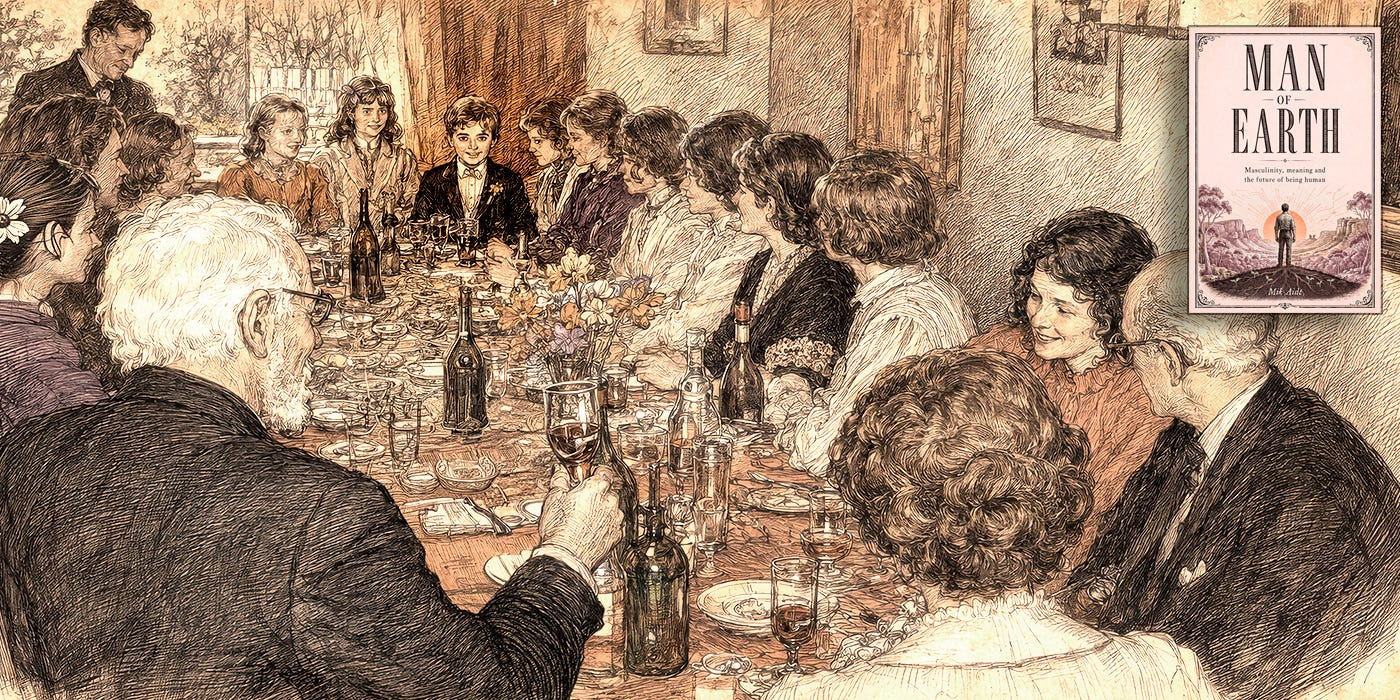
In April 1976, I was 14 years old. My family gathered to celebrate my confirmation – an old Danish tradition. After the church ceremony there were speeches, gifts and congratulations. One by one, the adults stood up and declared that I was now ‘crossing the line from boyhood into manhood’.
I expected something profound to happen. I thought adulthood would transform me into a different person.
But life simply continued.
Years later, in my 30s, I realised I was still the same person I had always been. The mysterious line I was supposed to have crossed had never appeared. Nobody had explained what becoming a man actually meant. Nobody had shown me what responsibilities came with it.
I had been told I was now a man. But I had never felt a transformation.
Now imagine a community in which the transition into adulthood is deliberately recognised.
A boy reaches adolescence. The people around him know that something important is happening. Childhood is ending. Adulthood is approaching. That transition is not left to chance.
Older men take an interest in him. Responsibilities gradually increase. Skills are taught. Expectations become clearer. Rituals may mark the passage from one stage of life to the next. The community recognises what is happening, and the young man himself understands that he is crossing a threshold.
The details varied enormously from culture to culture, but the underlying pattern recurs throughout human history.
Across much of human history, becoming a man was more than simply a biological event. It was a social event. The community acknowledged it. The elders guided it. The young man knew it.
Today, much of that structure has disappeared. Modern societies have become remarkably good at helping young people acquire information and professional skills. Schools teach mathematics, science, history and technology. Universities prepare students for careers.
Yet many young men reach adulthood without ever receiving an answer to a much older question: What does it mean to become a man?
The result is a curious situation.
A boy may learn how to drive a car, use a computer, pass exams and navigate social media. He may graduate from university and enter the workforce. Yet he may still feel uncertain about who he is, what is expected of him and what place he occupies in the wider community. Something important is missing.
. . .
WHEN BOYS INITIATE BOYS
In many initiation traditions, boys were removed from ordinary childhood life and placed under the guidance of elders. The rite of passage symbolically marked the death of an old identity and the birth of a new one.
The elders represented a wider horizon. They had already travelled the road ahead. They could challenge the boy’s assumptions and introduce him to responsibilities larger than status, competition and sexual conquest.
When initiation disappears, something interesting happens. Boys do not stop seeking initiation. They begin initiating one another.
The Australian sociologist Michael Flood documented this pattern in research involving young men at the Australian Defence Force Academy.
He found that among some groups of young men, male friendships took priority over relationships with women. The approval of “the boys” became a powerful organising force. Sexual activity became a source of status. Stories about women became a form of social currency. Other men were the audience before whom masculinity was performed.
In this environment, a young man was expected to prove himself not primarily to women, but to other men. Flood found that the men even had a derogatory term for someone who prioritised his girlfriend over his mates: a “WOM” – Woman Over Mates.
From the perspective of initiation, this is a fascinating study. Who was initiating whom here? In traditional cultures, elders often challenged boys to move beyond the need for approval from their peers. The task was to become a man capable of carrying responsibility for the wider community. In the absence of elders, however, boys remain trapped inside what could be called the peer circle of masculinity:
Status is granted by other young men. Your mates. Your approval to enter manhood is granted by your mates. Your identity as a man is granted by your mates.
In a 2025 Australian survey, almost half of the boys agreed that being thought of as gay makes a teenage boy seem like less of a man. The boundary of acceptable masculinity is still being enforced by fear of exclusion.
The result can be a strange paradox. Many heterosexual men believe they are pursuing women. Yet much of their behaviour is actually organised around impressing other men.
The fancy car. The muscles. The drinking stories. The sexual conquests. The risk-taking.
Often the audience sitting quietly in the background is not female. It is the tribe of mates.
Australia has a particularly strong mythology of mateship. It is one of the nation’s defining stories. There are many strengths in that tradition. Loyalty, solidarity, helping each other, resilience under pressure.
But every virtue has a shadow. A culture can become so focused on loyalty to the male group that emotional maturity, self-reflection and relationship skills become secondary. A man may learn how to be accepted by other men long before he learns how to be intimate with a woman.
One largely forgotten purpose of initiation was to help a young man become free enough to leave the tribe of boys behind and stop living for their approval.
. . .
THE FATHERLESS SOCIETY
The loss of initiation is part of a wider loss. In a conversation on Radio Information, Danish politician Alex Vanopslagh drew upon historian Henrik Jensen’s phrase ‘the fatherless society’. He used it to describe a culture in which recognised authorities have faded, and fewer adults are willing to tell the young: ‘Here is a worthy ideal. Try to live towards it.’
Vanopslagh suggested that many young men are hungry for exactly this. The hunger is less for a ready-made identity than for an ideal worth pursuing – and for an older voice able to say: ‘I expect more of you. You can do better. And I believe you can.’
The phrase ‘the fatherless society’ describes cultural fatherlessness rather than the literal absence of a biological father. It is the loss of a social function: adults who name the qualities adulthood requires, entrust young people with responsibility and accompany them as they grow into it. Fathers, mothers, teachers, coaches and elders can all carry that function.
When responsible adults vacate the role, irresponsible substitutes are quick to occupy it.
. . .
THE ROAD SOUTH
For me, the first real initiation I created for myself came through travel.
I was 18 years old and had just finished high school. A friend and I walked to the place where the highway began and stuck out our thumbs. We had a plan to hitchhike through Asia to Tibet, inspired by the Tintin comics.
We hitchhiked south.
We never reached Tibet. Eventually, we reached Juba, in South Sudan.
I still remember the feeling. Freedom so large it felt infinite. Sitting on the roof of a lorry under the African sky. Sleeping where we could. Riding on top of train carriages. Walking dirt tracks through heat and humidity that emptied the body during the day and remade it when the sun set.
We had left our Danish selves behind. Behind me was the shy boy I had been. The boy who felt trapped inside the expectations of his community. The boy who did not yet know how to approach a stranger. Out there on the African savannah, nobody knew him.
Nobody had a fixed story about me. I could begin again. I could build myself from scratch.
That is one of the great seductions of travel. You step outside the old mirror. You enter places where no one knows your weaknesses, your embarrassments, your family role, your school identity, your old silence. For a while, you are free from your own history.
And if initiation is a test of courage, this was the test.
People were dying around us. Some from malaria. Some in fights with spears or machetes. Some from bullets fired amid a conflict that was beginning to wake again while we travelled through the region. We heard the shots. We saw fear. We learned to read faces, roads, checkpoints, soldiers, scorpions, weather, hunger.
Danger.
There were rivers and swamps. There were enormous rounded rock formations rising out of the land, sometimes with the distant silhouettes of men carrying long spears. A sensation of deep time. The deep roots of our humanity.
There were nights when alcohol, officially forbidden, was quietly shared around the bonfire after dark. There were strangers who helped us and welcomed us in for supper, serving fish from the river that my stomach could barely accept. There were others we knew not to trust.
We walked for months. We carried very little. We learned when to speak and when to shut up. We learned that courage without caution is stupidity. We learned that the body can do more than the mind thinks it can.
At times we had to defend ourselves. More often the real test was restraint. Not to panic. Not to act tough for the sake of it. Staying alive required self-control.
We returned different. Fully alive. Also carrying nasty amoebas in our digestive systems, which required Western medicine to remove.
Looking back now, I can see that the journey gave me something important. It gave me distance from the fragile boy I had been. It gave me the danger and freedom I had been craving. It taught me endurance and self-reliance. It gave me the feeling that I could walk towards the unknown and not disappear.
It also taught me something I didn’t tell my parents about. I learned how the nearness of death can give you an incredible feeling of aliveness – of presence in the moment.
I came home treasuring every moment, but also with a taste for danger. That taste can become addictive. It can make ordinary life feel too small. Too safe. Too slow.
This was an initiation without elders. No one sent us. No one received us back. No older men sat us down afterwards and helped us understand what we had learned. No community said: “Now you have seen something. Now you carry a responsibility.”
So the journey changed me, yes. But it did not complete the journey of maturity.
It gave me the thrill of becoming, the thrill of danger. It did not give me the deeper task of belonging.
Many young men do something similar. They travel, fight, drink like hell, climb, race, risk, escape, conquer and survive. They place themselves in danger because danger feels like a doorway.
But without guidance, without reflection, without a community to return to, the doorway may lead only to another version of performance.
I had found freedom. I had found a new self. I had not yet found my place in the world.
. . .
MAN IN RELATIONSHIP
Anthropologists often describe rites of passage as consisting of three stages.
First comes separation. The young person leaves behind an old identity.
Then comes a period of uncertainty and transformation. The old role has disappeared, but the new one has not yet fully emerged.
Finally comes reintegration – sometimes called incorporation. The individual returns to the community with a new identity and a new place within it.
Traditional societies created rituals around this process because they understood something that modern societies often forget: transformation rarely happens by accident.
It requires attention. It requires guidance. And it requires witnesses. A young man does not become a man alone. He becomes a man in relationship.
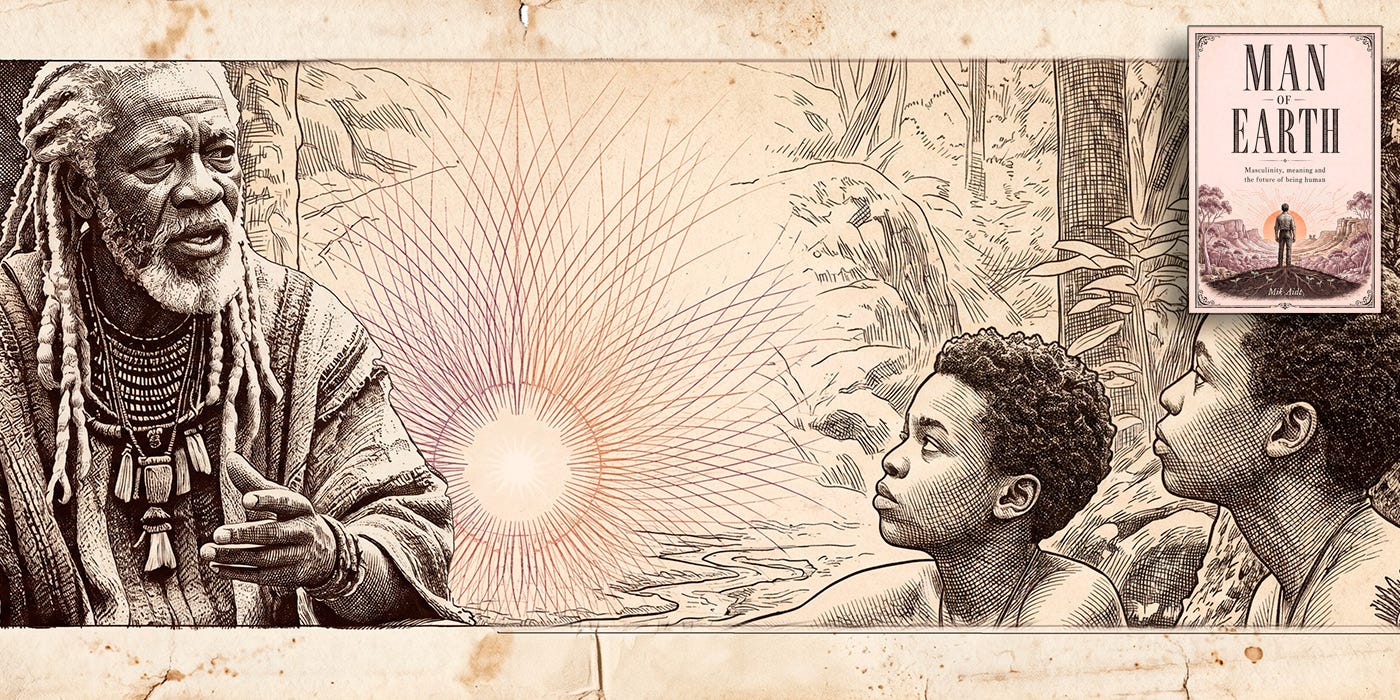
Anthropologists have documented initiation ceremonies across all inhabited continents. The details varied enormously. Some involved fasting, solitude, scarification, storytelling, ordeal, mentorship or spiritual instruction. Others involved dramatic bodily rituals that can seem confronting to modern readers.
The bodily marks used in some initiations still echo in modern Western life. A tattoo can reveal a longing many men carry: the longing to be marked by meaning.
What many of these rituals and ceremonies have in common is that traditional cultures understood that manhood was not merely a biological event. It was a psychological and social transformation.
Fatherhood can be understood as one of the most profound rites of passage still available to modern men. Yet it usually arrives without ritual, elders, preparation or communal recognition.
A 2026 survey of 1,216 Australian fathers found that 84 per cent said becoming a father gave their lives greater meaning, while 77 per cent said it helped them express love and vulnerability more openly.
More than two-thirds said they were more involved in everyday care than their own fathers had been.
Yet one in five also became more isolated or lonely, and three in five were never asked by a health professional how they were coping. The transition into fatherhood asks a man to become a provider, protector, carer and emotionally present father – often without guidance. No elders and no rituals ensure that we understand what is required of us.
. . .
REBIRTH
Some anthropologists have interpreted particular initiation practices in parts of Australia and New Guinea as symbolic attempts to imitate menstruation, pregnancy or birth. Whether or not those interpretations are correct, the practices point towards an important insight: some societies placed male initiation within a larger relationship to women, reproduction, community and life itself.
Modern society largely abandoned the rituals, but it never replaced the underlying task. In modern Western societies, boys may spend time with older men at school, in sports clubs and, of course, with their fathers.
Skills are passed on and mistakes corrected, certainly. But boys are rarely taught what adulthood looks like, how to navigate sexuality, responsibility and relationships, or which values matter and why.
This is where the modern situation becomes problematic.
Over the past century, many of the traditional institutions that once guided young men have weakened or disappeared. Extended families have become less common. Communities are more mobile. Religious participation has declined. Apprenticeships are rarer. Many boys grow up with limited contact with older male mentors outside their immediate family.
At the same time, the traditional script of masculinity has become increasingly uncertain. The old answers no longer satisfy. The new answers remain incomplete.
The result is a vacuum.
Human beings rarely tolerate a vacuum for long.
When a culture no longer provides clear pathways into adulthood, people begin creating their own. Some young men seek initiation through sport. Others seek it through military service. Others through risk-taking, entrepreneurship, adventure, fitness, online communities, gangs, political movements or extreme ideologies.
The specific form matters less than the underlying need. Many of these activities are attempting to answer the same question: How do I know when I have become a man?
This question helps explain the appeal of many contemporary men’s movements.
The popularity of wilderness retreats, fatherhood groups and rites-of-passage programmes is evidence that modern men continue to seek experiences that earlier cultures often provided more deliberately: belonging, recognition, responsibility and a sense of purpose.
Beneath the language of masculinity lies a deeper longing – to be seen, recognised and assured that one’s life matters. To know where one belongs.
This helps explain why some young men are drawn towards more extreme masculine movements.
The manosphere, for all its flaws, offers something that many institutions no longer provide. It offers certainty. It offers identity. It offers a sense of brotherhood. It offers a story about what it means to be a man.
Whether that story is healthy is another question entirely. But the need it is responding to is real.
. . .
BELONGING FIRST
A rite of passage is often described as a movement into maturity. It asks a young person to step forward into responsibility.
That is true, but it is not the whole truth.
An initiation may also require the young adult to return for the parts of himself that fear, shame or ridicule forced underground – parts of the self left behind during childhood.
As children, we learn very early what is welcome in the family system and what is not.
Some children learn that anger is dangerous. Some learn that sadness is weakness. Or that expressing joy is ‘too much’.
Some boys find out that showing sensitivity only invites ridicule. Some girls learn that being confident is seen as arrogance.
So the child adapts.
To belong, the child becomes smaller and quieter, more obedient, more invisible – or harder and louder, tougher, funnier. Whatever works.
This is not a failure. It is survival.
In many traditional cultures, initiation was not simply a private test of courage. It happened inside a community. Boys were taken from the world of childhood and gradually received by older men, elders, fathers, uncles and teachers who could show them what adult responsibility looked like.
When that chain is broken, something else happens. Boys still grow up, of course, but they are not guided into their manhood. They improvise it. They copy what they see. They protect themselves as best they can.
War has broken this chain again and again. Men are taken out of families and communities, and some do not return. Those who return may be physically alive but emotionally unreachable. Their sons are then left to make sense of absence, fear, silence or hardness without knowing the larger story behind it.
I can see this in my own family history. During the Second World War, my grandfather was a leader in the resistance movement against the German occupation. He was captured and sent to a concentration camp.
From one angle, that was an act of courage. For his children, however, it would also have been frightening. A child does not understand history, politics or sacrifice in the abstract. A child feels presence or absence. Safety or danger. Warmth or withdrawal.
This is how the history of the world enters the nervous system of a family. But what helped the boy survive may later imprison the man.
The boy who learned not to cry becomes the man who cannot grieve.
The boy who learned to perform – to be the funny one who makes everyone laugh – becomes the man who does not know who he is when nobody is applauding.
The boy who learned to control every game becomes the man who does not know how to love unless he is in charge.
This is where initiation becomes something more significant than an achievement, a ritual or an exam. Underneath, initiation is not about proving strength or perseverance. It is about meeting those parts of ourselves that we exiled in order to be accepted.
So when the Man of Earth is asked to become more whole – not perfect, but whole – that means learning to recognise the old strategies of his childhood without being ruled by them.
It means finding the frightened child beneath the defensive adult.
It means discovering that tenderness, grief, uncertainty, creativity, sensitivity and humility were never enemies of his manhood. They were parts of life waiting to be welcomed back.
This transformation cannot happen only in the mind. The body remembers what the mind has learned to explain away. Fear, shame, grief and longing live in the chest, the belly, the throat, the breath, the shoulders, the nervous system, the posture.
A man may think he understands everything intellectually but still remain trapped in the old patterns of his childhood if his body has not learned that it is safe to soften, to breathe, to stay grounded.
So the rite of passage is not only forward. It is also downward, inward and homeward.
This is why maturity includes the capacity to ask for help.
A mature man is not the man who never struggles. He is the man who can say, “I am not coping,” before the damage spreads.
He can say, “I don’t know,” without collapsing into shame. He can take responsibility for what he has said and done, even when he was frightened, provoked or overwhelmed. That is where repair begins.
A child adapts to survive. A man begins his return when he can see those adaptations clearly, honour what they once protected, and choose a larger way of being.
Through initiation, a man can begin his journey to wholeness.
. . .
MEANINGFUL TRANSITIONS
In my life, something special happened when I became a father. Suddenly another human life depended on me. I began to see the circle of life in a way I never had before. Watching my children grow, I saw reflections of my own childhood. I became aware of generations stretching behind me and ahead of me.
Looking back, I suspect fatherhood was my first true initiation into responsibility. Nobody organised a ceremony. Nobody gave a speech. Yet something fundamental shifted. Responsibility was no longer an abstract idea. It had become deeply personal.
The challenge for our civilisation is not to recreate ancient initiation rituals exactly as they once existed. Many traditional societies also contained rigid hierarchies and assumptions that no longer fit the modern world. Yet it would be foolish to dismiss the underlying need that those rituals served.
Youth organisations face a related problem: many struggle to find enough male mentors, coaches and adult role models. Too often, when they call for volunteers, men do not step forward.
We need men in community life. We need men in youth work, sport, mentoring, neighbourhood groups and civic institutions. Yet many of the same men who feel lost, lonely or without purpose are missing from the very places where purpose is formed.
This is one of the quiet tragedies of the man without a map. He may be longing to matter, yet he does not step into the spaces where his presence would matter deeply.
AI companions may soon offer lonely men something that feels like intimacy without requiring the courage that intimacy demands. The machine does not reject them, misunderstand them or ask them to change. It listens, reassures and remains available. But a relationship without risk, reciprocity or responsibility cannot initiate a boy into manhood. It may soothe his loneliness while quietly making him less capable of overcoming it.
A society loses something important when men withdraw from the places where guidance, trust and belonging are built.
Human beings require meaningful transitions. We need moments when responsibility increases. We need opportunities to contribute. We need elders who can share wisdom without demanding obedience. We need communities that recognise our growth.
Most of all, we need a sense of belonging.
This may be why so many modern discussions about masculinity eventually circle back to themes that seem only loosely connected to gender: friendship, mentorship, purpose, community, service and connection.
What we discover then is that the deeper story is about becoming fully human. It is about becoming whole.
A healthy initiation would not teach a young man that he is superior to others. Nor would it teach him that he is insignificant. It would teach him that he has a place and a role.
So what is the place of a man in a civilisation organised around relationship rather than domination?
Before a man can answer that question, he must first experience something that previous generations often took for granted.
He must feel that he belongs.

Reflections
Where did you agree, disagree or feel challenged?
Which ideas or statements stayed with you after reading this?
Did this chapter remind you of anything in your own life?
What experiences, perspectives or examples would you add?
. . .
I read every comment and appreciate thoughtful disagreement as much as agreement.
Thank you for being part of the conversation.
~ Mik
I really like your exploration of this.