Take back our country
If someone truly wants to “take back our country”, perhaps the real task is to take it back from the misinformation that keeps Australians arguing about yesterday’s energy system.

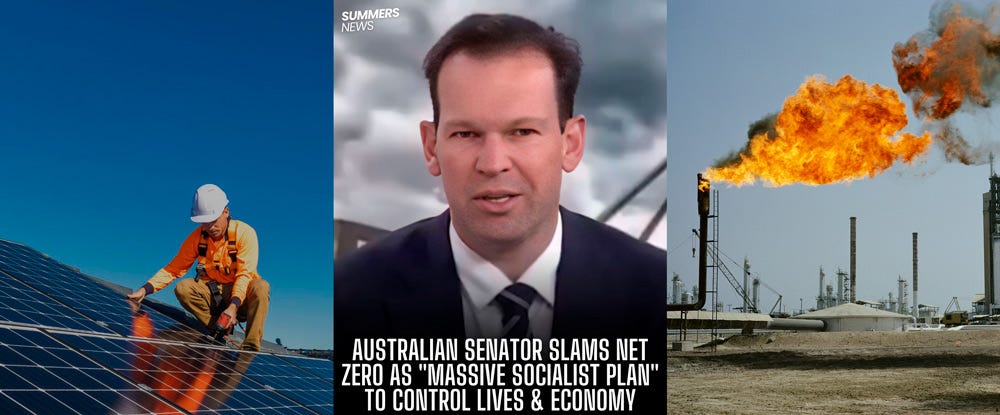
“Take back our country.” That’s what coal-loving Senator Matt Canavan wrote on Facebook after becoming the new leader of The Nationals. He wants to take back our country.
Take it back from whom?
From the millions of Australians who have installed solar panels on their roofs?
From the farmers securing their economy by hosting wind turbines on their land?
From the investors and engineers building the world’s largest grid-scale batteries?
Or – as Trump is doing in America: from the scientists warning us that the climate system is approaching dangerous thresholds?
One can only wonder why. Because if we look at what is actually happening in Australia’s energy system, the story is very different from the one Canavan tells.
The myth of a “failed” net-zero policy
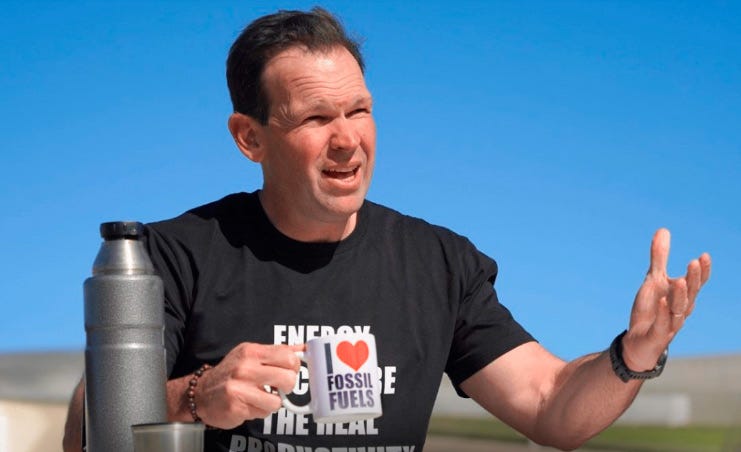
Canavan regularly claims that Labor’s net-zero policy has “failed”. That’s easy enough to say. But the facts tell a very different story.
In the December quarter of 2025, renewable energy and batteries supplied more than 50 percent of electricity in Australia’s National Electricity Market for the first time in history. At the same time, wholesale electricity prices fell by around 44 percent compared with the previous year.
Coal generation fell to record lows and gas generation dropped to its lowest level for that quarter since 2000.
In other words: more renewables mean less fossil generation – and lower electricity prices.
Canavan claims this happens because of an “ideological opposition to drilling for our own fuels.” That is a misguided – or intentionally manipulative – claim. This has nothing to do with “ideology”. It is how electricity markets work.
Renewables have near-zero fuel costs. When they enter the market, they push expensive fossil generators out of the supply stack – a phenomenon economists call the merit-order effect. The result is cheaper power.
Cheaper!
Meanwhile, we have politicians such as Barnaby Joyce, Pauline Hanson, Angus Taylor, Littleproud and numerous other Australian politicians constantly spruiking – as Mr Canavan did on Facebook the other day – that "small businesses in Australia are facing skyrocketing power prices and increasing fuel insecurity. Both are home-grown issues, driven by Labor's failed net zero policy and ideological opposition to drilling for our own fuels."
. . .
Australia’s renewable revolution
The scale of Australia’s energy transition is often underestimated.
In 2010, renewable energy produced just over 10 percent of Australia’s electricity. Today it is approaching 45 percent of the national electricity mix and rising quickly. That is one of the fastest energy transitions ever recorded in a developed country. It is actually something to be proud of!
The reason is simple. Australia has extraordinary renewable resources. We have more solar radiation than almost any other developed country. We have vast land suitable for wind generation, and a high household uptake of rooftop solar.
Solar alone generated about 20 percent of Australia’s electricity in 2025 – an extraordinary milestone. That is because roughly one in three Australian homes now has rooftop solar, one of the highest rates in the world. There are now over 4.3 million solar systems installed across the country, according to the latest data from the Clean Energy Regulator and the Clean Energy Council.
In October 2025, there were 55 separate half-hour intervals where the input from renewable energy actually exceeded 100 per cent of the grid's demand,
These figures are not ideology, Matt and Barnaby. They are economics. None of this happened because people were forced to install solar panels. They did it because it saves money while at the same time helping prevent climate breakdown.
. . .
Australia is doing better than we think
Australia is often portrayed as lagging behind Europe in climate action. But in some respects the opposite is true.
Across the European Union, wind and solar together generated about 30 percent of electricity in 2025. In Australia, wind and solar plus hydro already produce around 40 percent of electricity.
However, more striking still is the pace of change. While Australia’s renewable share has grown from about 10 percent to roughly 40 percent in just over a decade – an increase of around 30 percentage points – in the EU, the comparable increase over the same period has been smaller.
Australia’s electricity system – once one of the most coal-dependent in the world – is now transforming at extraordinary speed.
. . .
The fantasy of “drilling our way to energy security”
Another claim frequently repeated by Canavan and others is that Australia should simply “drill for our own fuels”. But this argument ignores basic realities.
First: Australia does not have large oil reserves. Australia has coal and gas – but most of its oil is imported, and always has been.
Second: Australia is already one of the world’s largest exporters of fossil fuels. The country exports vast quantities of coal and liquefied natural gas every year.
Domestic shortages are not caused by a lack of production. They are caused by the fact that exporters can often earn more selling gas overseas than domestically.
Opening new gas fields does not automatically lower domestic prices. In many cases, it does the opposite.
. . .
The economic trap of fossil fuels
There is another reason why doubling down on fossil fuels makes little sense: The global economy is moving away from them.
The European Union is introducing carbon border tariffs. These policies will effectively tax imports from countries that produce goods using high-emissions energy.
For an exporting country like Australia, this matters enormously. Steel, aluminium and other industrial products produced using fossil fuels will become harder to sell internationally.
So when Senator Matt Canavan writes in a recent Facebook post that he “loves the smell of Aussie-made steel in the morning”, and “to revive our country, we need more Aussie businesses, more Aussie manufacturing and more Aussie jobs,” while then in the next line he repeats his never-ending call for more fossil fuels… what part of this equation is it that Mr Canavan, a politician who often refers to himself as an ‘economist’, pretends not to understand?
Cheap renewable energy makes steel easier to sell internationally. This advantage allows manufacturers to produce goods with lower emissions and lower energy costs. Which is exactly why countries around the world are investing heavily in renewable energy. Not because of ideology, but because of economics.
. . .
The part of the story politicians avoid
There is also a deeper issue.
Burning fossil fuels is destabilising the climate system on which modern civilisation depends. This summer in Australia has offered a brutal reminder.
Hundreds of thousands of hectares burned in Victoria. A thousand homes, farms and buildings were destroyed. Australians experienced seven destructive cyclones. Floodwaters sweeping cars into the ocean. A massive algal bloom lingering off South Australia for nearly a year.
Insurance data suggests that fires, floods, heatwaves and storms have already caused about $1.6 billion in insured losses this summer alone. And that number captures only a fraction of the real cost.
The science is straightforward. Global temperatures are rising because carbon emissions trap heat in the atmosphere. Ocean temperatures are at record highs. Ice sheets are melting. Sea levels are rising. Extreme weather events are becoming more intense.
This is not ideology, Matt. It is physics.
. . .
Lower power bills – the Victorian reality
There is another development worth paying attention to.
For years we have been told that renewable energy would drive electricity prices up. But in Victoria, the opposite is now beginning to show up in people’s power bills.
The state’s energy regulator, the Essential Services Commission, has set a lower Victorian Default Offer for the coming year. That means the benchmark electricity price for many households will fall.
For an average household the reduction is expected to be around $50 a year, and for small businesses the saving is estimated at about $170.
These are not enormous sums. But they are important because they illustrate something fundamental about the way electricity markets work.
Renewables now supply close to half of Victoria’s electricity. Wind and solar have extremely low operating costs – once the infrastructure is built, the energy itself is essentially free. When these generators enter the market they tend to push wholesale electricity prices down.
Wholesale prices are only one part of a retail electricity bill. Network charges and other costs still make up a large share. But wholesale prices remain one of the key drivers.
And over the past year Victoria has recorded some of the lowest average wholesale electricity prices in the National Electricity Market, at the same time as renewables have approached half of total generation.
This is exactly what energy economists predicted would happen.
As more low-cost renewable energy enters the system, expensive fossil-fuel generators are used less often. Over time that puts downward pressure on electricity prices.
Victoria has set targets of 65 percent renewable energy by 2030 and 95 percent by 2035. If those goals are achieved, the state’s electricity system will be almost completely decarbonised. The final few percent of emissions are likely to be the most difficult and expensive to eliminate – but the direction is already clear.
Again, this transition is not something abstract or ideological. It is beginning to show up in the most practical place of all: People’s electricity bills.
Once households and businesses begin to experience the economic benefits of cheaper renewable power, it becomes very difficult to turn that momentum around.
In Victoria – where renewable generation is approaching half of the electricity mix – wholesale power prices have been among the lowest in the National Electricity Market, and consumer bills are now beginning to reflect that change.
The contrast between states is striking. Victoria is approaching half of its electricity from renewables and helping lift the national average, while Queensland – Senator Matt Canavan’s home state – remains far more dependent on coal and continues to lag behind.
Victoria now generates roughly twice the share of electricity from renewables as Queensland – even though Queensland has some of the best solar resources in the world.
. . .
Desire for clean, cheap and independent energy
The evidence emerging in the electricity market points in the opposite direction of the political narrative promoted by the Nationals, the Liberals, and One Nation.
Even in countries like Germany, where solar resources are far less generous than in Australia, people are installing small “balcony solar” systems simply to gain a little more control over their energy costs.
The desire for clean, cheap and independent energy has become a powerful force in its own right. And that is a force no political slogan can stop. Which makes the claim that net-zero policies have “failed” increasingly difficult to sustain.
As an Australian with Danish roots and a fairly close view of the green transition internationally, I sometimes hear something surprising when speaking with people in Europe: Some of them have told me they feel sorry for Australians.
Not because Australia lacks renewable resources – quite the opposite. Australia may have the best renewable energy potential of any developed country on Earth.
But because so much of the public debate here still revolves around narratives that no longer match what is actually happening in the energy system.
Donald Trump once used a word for situations like that: people are being “conned.”
His intention, of course, was to suggest that climate science itself is the con. But the evidence increasingly suggests something else is going on.
The real deception is the political story that tells Australians renewable energy is a failure even as the electricity market itself quietly proves the opposite.
And yet the political narrative continues. Matt Canavan and his allies are riding the same political bandwagon that Donald Trump has popularised – repeating false claims that renewable energy has failed even at a time when the electricity market quietly demonstrates the complete opposite.
Perhaps they believe Australians will continue to accept that story. But sooner or later voters tend to notice when the evidence no longer matches the slogan.
. . .
Stop the theatre
You’ll often hear politicians and media people refer to this as a “climate crisis”. But that phrase is itself misleading, because the climate is not the cause. This crisis is the damage humanity has inflicted on the Earth’s systems over many decades. Damage that is now finally becoming clearly visible to everyone.
For decades the damage accumulated silently in the atmosphere and oceans. Now nature is responding. The fires, floods and storms are not the cause. They are the symptoms.
So when politicians like the leader of the National Party claim that net-zero policies have “failed”, they are not describing reality. They are performing political theatre. To them, it would appear, this is all a game.
The reality is clear:
Renewables are expanding rapidly. Electricity becomes cheaper when renewables dominate the grid. Solar and wind are now the cheapest forms of new power generation. And the global economy is moving toward low-carbon production.
These trends will not reverse – no matter how loudly fossil-fuel politicians wish they would.
The only real question is whether Australia chooses to lead the transition – or cling to an industry the rest of the world is leaving behind.
. . .
The science is screaming
The climate system does not negotiate. Every tonne of carbon dioxide we release remains in the atmosphere for centuries. Scientists have been warning about this for decades.
The message is now unmistakable: To stabilise the climate, humanity must rapidly reduce and ultimately stop burning fossil fuels.
Every tonne of coal burned, every new gas field opened, every delay in the transition pushes the climate system further out of balance.
The fires, the floods, and the heatwaves are not random misfortunes or “Mother Nature’s fury”. They are the bill arriving for decades of choices made by politicians who insisted nothing had to change.
And the most disturbing part is this: the damage will not fall primarily on those who delayed action. It will fall on our children.
So when politicians talk about “taking back our country”, perhaps the real question is this:
Will we take it back from the misinformation and denial that got us here – or will we allow the same voices to keep steering us deeper into a crisis they still refuse to name?
Three facts about fossil fuel subsidies in Australia
Australia spends billions subsidising fossil fuels every year
Despite political claims that fossil fuels are under attack, governments in Australia subsidise coal, oil and gas heavily with taxpayer dollars.
According to the Australia Institute and other energy analysts, federal and state governments together now provide around $14–16 billion per year in fossil fuel subsidies through tax concessions, fuel rebates and other financial support.
That is public money used to lower the operating costs of some of the most profitable industries in the country. If fossil fuels were truly being squeezed out of the economy, these subsidies would not exist. Yet they continue – year after year.
The single biggest subsidy: the diesel fuel tax credit
The largest fossil fuel subsidy in Australia is the diesel fuel tax credit scheme.
Mining companies, large agricultural operators and other industries receive rebates on diesel fuel used off public roads. This program alone costs taxpayers roughly $8–9 billion annually.
That means Australian taxpayers are effectively helping reduce the fuel costs of some of the world’s largest coal and gas exporters. It is difficult to argue that fossil fuels are being persecuted when the public is still paying billions to support their consumption.
The real cost of fossil fuels is far higher than what appears in the budget
Economists often point out that official subsidies only tell part of the story. When the broader social costs of fossil fuels are included – health impacts, pollution damage and climate risks – the International Monetary Fund estimates that Australia’s fossil fuel subsidies effectively amount to more than $40 billion per year.
Those costs are not paid by the companies producing fossil fuels. They are paid by society.
Through higher insurance premiums, disaster recovery spending, health costs and environmental damage. In other words, fossil fuels do not merely receive subsidies. They also pass many of their real costs onto the public.
Related article
RenewEconomy - 11 March 2026:
“Mr Coal” and hater of the home battery rebate is the new leader of the National Party
“Matt “Mr Coal” Canavan – the chief agitator for the federal Coalition’s abandonment of net zero and probably its most vocal anti-renewables member – has been elected to lead the National Party.”