
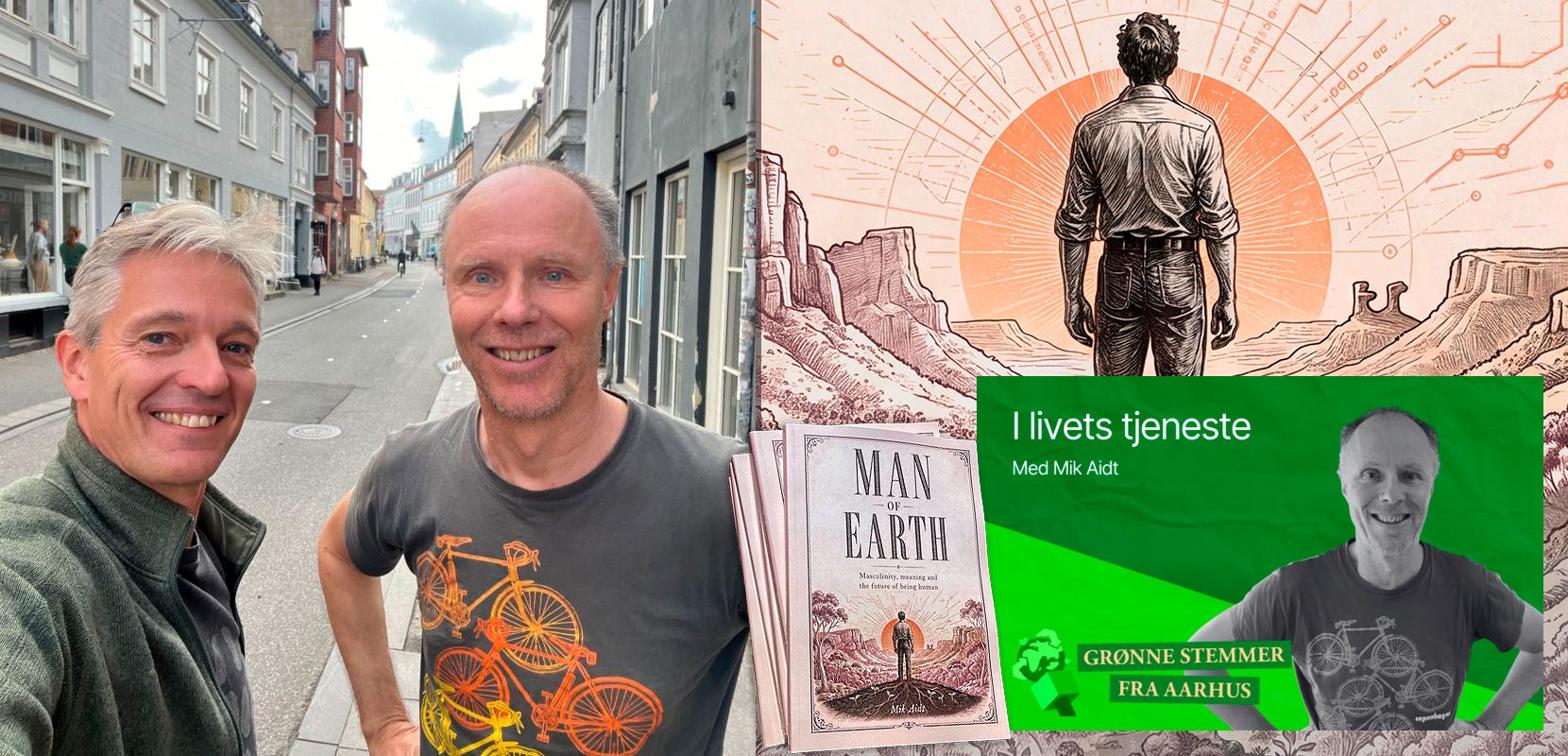
During a recent visit to Denmark, I sat down with journalist Bjørn Olsen at Frontløberne’s studio in Aarhus to talk about sustainability and my new book, Man of Earth – Masculinity, meaning and the future of being human.
The conversation was recorded for his podcast, Grønne Stemmer fra Aarhus – Green Voices from Aarhus. We talked about my years of climate activism in Australia, but when we reached the book, the discussion became more personal.
Bjørn put one of its central arguments into one short question:
Bjørn Olsen: “So today’s climate struggle starts in our relationships with our partners?”
Me: “Yes, that’s actually what I’m arguing.”
I am exploring this in the book. The way I use power, the way I respond to other people’s needs and understand my responsibilities as a man belongs in the conversation about the future we are building. And there is a connection there to how I behave as a citizen and which ecological choices I make – or fail to make – in my dailyday.
. . .
In service to life
Through The Sustainable Hour radio show and podcast, I have spent years talking to people about the climate crisis and ways forward. More recently, I have been thinking about the language we use, and how to have constructive conversations with people who switch off when they hear the word “climate”.
An interview with British sustainability expert Joseph Gelfer helped move my thinking in a new direction when he told me:
“If you are not in service to life, you don’t deserve to be in business.”
That sentence stayed with me. I began a podcast series called Force of Life, exploring what it means to put life at the centre of our decisions. When Bjørn asked about the expression, I described a deliberate shift from being a climate activist to being a “life activist” – with a twinkle in my eye.
Then another question began to occupy me. At the climate activist meetings I attended, I would often look round the room and find that eight out of ten people were women. I would be one of the two men. Why were so many men persistently missing from those community meetings?
That observation lead me towards writing the book. Alongside the work of protecting life, I wanted to explore our understanding of ourselves as men, and the ideas about manhood we carry into that work. I started exploring and researching our history, our biology, our culture, our rites of passage, or lack of them, asking: Is there a link between the way men are expected to behave in society and the way men relate to nature and the climate?
. . .
The man I am asking myself to become
Bjørn had brought the book into the studio. He read a passage from page 7 in Danish:
“We need new ways of understanding our world. New forms of adulthood. New ways of understanding what freedom, desire, power, responsibility, love and belonging mean. More specifically, we need men who are not shaped by domination, avoidance or entitlement, but by presence, humility, courage and care. The task ahead is not merely to change policies, technologies or markets. It is to grow into a different kind of human story – one grounded in science, guided by life itself, and capable of helping future generations inherit a planet that is still generous, beautiful and alive.”
Those words ask something of the person who wrote them.
In the interview, I told Bjørn about the connections I see between the urge to dominate, the pursuit of wealth in the fossil fuel industry and the macho values promoted in the manosphere. I also argued that we need to look inward and examine the habits we have inherited ourselves.
“My biggest question is: what should the new man look like? And I’m speaking to myself here. How should I see myself as a man from now on? In the world I want to live in, which is a sustainable world.”
That means looking not only at our history and culture, but also to include experiences of women that I until then had not understood well enough.
It also means asking how much of men’s behaviour is determined by biology and hormones, a question I explore in the book.
Biology influences us. But we get our expectations about care and responsibility from the societies around us.
“You can go to different societies around the world and see that they’ve organised things completely differently. The respect between genders, for example. The way men care for very young children can be completely different in other societies too.”
What I take from that observation is that we have room to change. The roles we grew up with can be examined. The answers young men learn from the manosphere influencers in particular needs to be examined. As men we are able to learn different ways of being useful, caring and strong.
. . .
Where the book puts me to the test
Bjørn commented: That can be a difficult realisation for men listening to this and perhaps thinking, “What? Do I have to change?”
“Yes, and it has been difficult for me too. And I can tell you, now that I’ve published the book, I have to answer for what I’ve written. I have women in my life too. I have my sister. I have a girlfriend. They’re holding me to what I’ve written now.”
If in my book I sing from my high horse about presence, humility, courage and care, the people close to me have every reason to expect those qualities in how I behave.
At home, respect means making space for another person’s needs and carrying a fair share of the work. It means staying present in conversations I would prefer to avoid. These are things I can practise, and things another person can judge from my actions.
That is why relationships have such an important place in Man of Earth:
“I’ve dedicated a whole chapter to that in the book, because I think relationships are really where you find out whether you’ve passed the test as the new man. It becomes very, very obvious if you haven’t, you could say.”
The habits we practise with other people travel with us into workplaces, organisations and public life.
I want to understand how we men can use our strength in ways that serve the life around us, and how we help one another keep practising that.
One of my hopes for the book is that more men will start meeting regularly. A bar once a month, perhaps, or a walk on a Saturday morning. Somewhere we can talk honestly about the men we are becoming, what we are learning and where we are struggling.
I would like the book to give us something to bring into those conversations. I need them too.
If you read Man of Earth, I would like to hear what it asks of you. I am also interested in what you think it should ask of me.
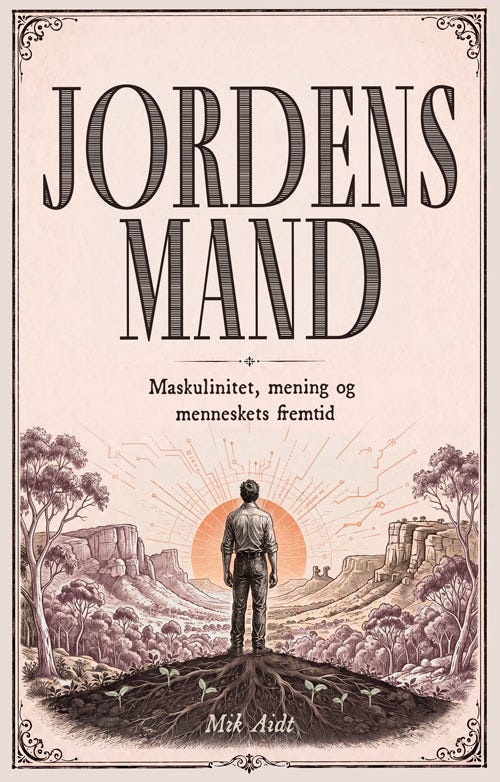
Read more about Man of Earth. I am also working towards a Danish edition, with the aim of having it ready before Christmas.
Listen to the full conversation with Bjørn Olsen. The interview is in Danish; the excerpts above are from a translated transcript.